Our collaboration with Enabled Minds was fantastic. They built a flexible and scalable solution that addressed our biggest problem—overcoming pervasive biases that reflect common human misconceptions. The team took the time to understand our philosophy and came up with creative ways of testing. They made sure we were part of the process every step of the way, and got it all done in lightning time.

01 · Challenge
A worldview most models argue with
Animal Ethics wanted an AI assistant to help people learn how future technologies could reduce harm to animals in nature, especially at scale. The hard part wasn't the chat—it was the philosophy behind it.
Reflecting a precise philosophy
Animal Ethics prioritizes the welfare of sentient beings—sometimes above environmental considerations. Off-the-shelf models lean the other way, echoing common human misconceptions. The assistant had to mirror the organization's position precisely without reading as biased to people who hold opposing views.
8 weeks, two gates
The timeline was strict. We had 2 weeks to prove we could control the model's biases and stand up the necessary tooling—then 6 weeks to build the chatbot itself.

02 · Solution
A feedback loop and swappable parts
Bias found, prompt fixed, repeat
We set up a feedback loop with Animal Ethics: identify biases, provide context, test question-and-answer rounds, gather the client's review of responses, and refine the prompts. That collaboration is what made the fast deployment possible.
Answers checked before they ship
The chatbot retrieves quotes from the database, constructs a response, and verifies it against the bias list before delivering the final answer—so the philosophy holds even on questions nobody scripted.
Microservices around a swappable model
The solution splits into focused services: OpenAI embeddings, a Claude-based chatbot, a database, a document-import service, and an API gateway. The LLM provider can be swapped without rebuilding the rest—useful while the AI field keeps moving this fast.





03 · Results
Accuracy you can count
Accuracy that climbed every cycle
Fast review rounds from Animal Ethics drove steady prompt improvements. By the end of the loop, the chatbot's response correctness rate reached 70%—measured against the organization's own review of its answers.
An interface that invites questions
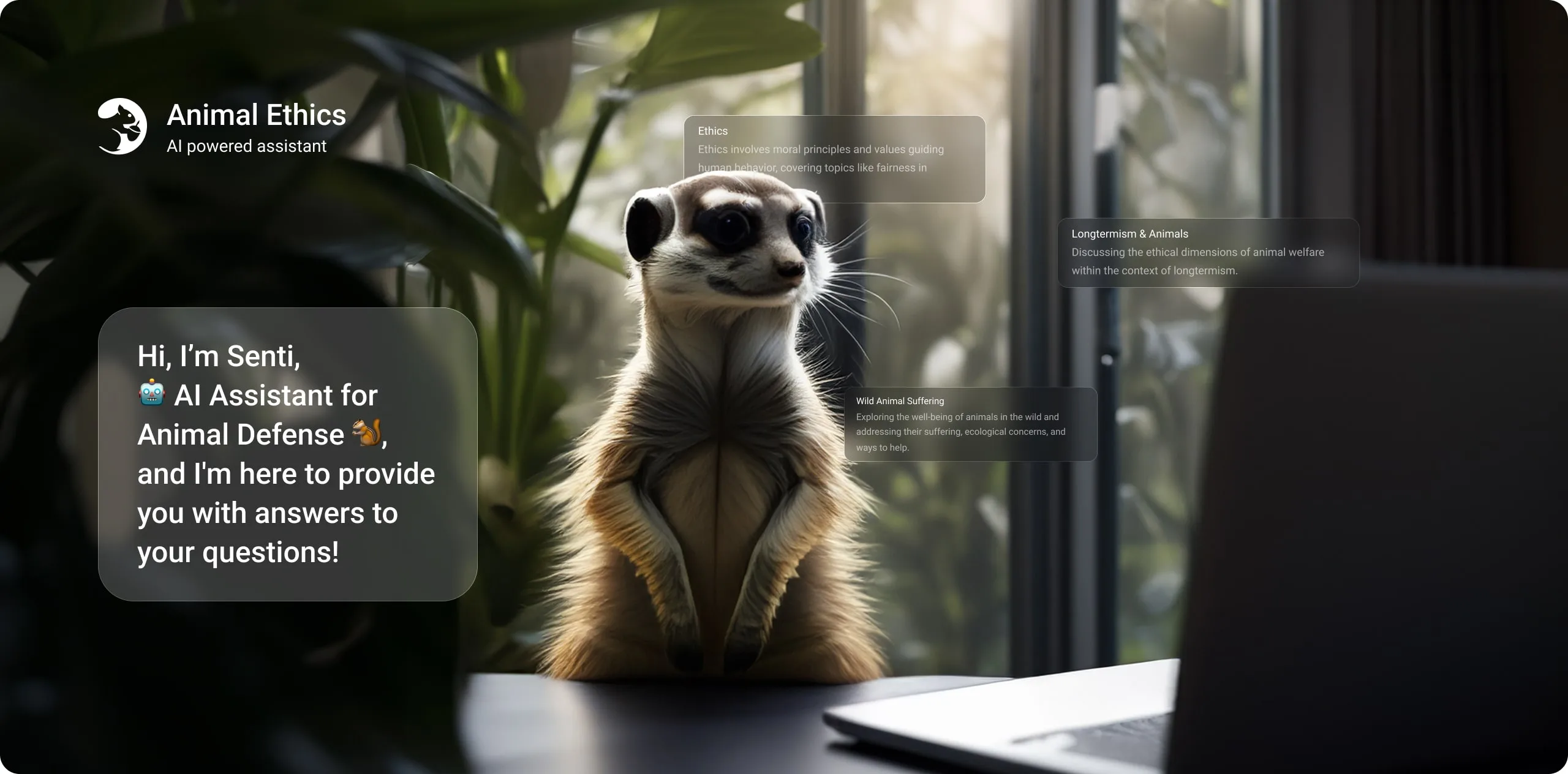
Senti sits behind a floating button on the Animal Ethics website. It opens on the 3 most important topics with example questions, covers 10 topics in total, and links out to source material—so a chat answer becomes a doorway into the research.